Saturday, June 29, 2024

"What God Wants, God Gets. God Help Us All" - Confronting GOPathology & It's Dark Deity - How Evil Comes With Ketchup & Fries


Metal Window Sculpture - Made in Haiti

The alarums are sounding again. Have been sounding, endlessly, too often ignored by the smug entitled "righteous" ones who would and will and do threaten retribution, violence upon those who resist their tyranny.


Citizens of authentic good will decry, denounce, condemn and counter delusional MAGA-magpies, the dark side of Power has seized them, an ancient yet very alive and active archetype insisting

POWER OVER ALL/UBER ALLES (armed wth guns and Bibles - chapters and verses used to further the delusions of grandeur.

They are seized by a destructive, vengeful, blood-thirsty Force that convinces and confirms to their simple minds that they are the army of "the one and only TRUE God

(but let's face it,

ALL DEITIES ARE LOCAL.

Just read the history of religions, the big ones and the regional ones.

Boring, you say?

Then go play the consumer ADD/ADHD game and be Entertained to Death (aka Roger Waters). Go TIK TOK, go binge watch all the zillions of ways to remain "comfortably numb" all of which is, amounts to

post modern fiddling while all our Romes burn, Rome, Georgia, Rome, Italy, et. al.

So you follow God, is it?

But which God is it, Delusional Crusaders?

Ah, though dressed up in 2024 drag it is the too very familiar, all too violent, psychopathic deity especially found in Western Religions though such deity is an equal opportunity Crazy the world over, - land hungry, blood thirsty, fear/terror mongering bully, a mind-fucker conveying both sides of the primitive mouth (dripping blood and cruelty)

"I love you/I destroy you".

A VERY SICK DEITY

and as goes the deity so goes its followers.

Thusly, and to be Biblical,

"And it came to pass" that

Roger Waters lays it, all the absurdity of Western theology and culture, all out:

"What God wants, God gets - God help us all"...

Just this refrain reveals the crazy making that comes with such a God/Religion, the tri-invecta here -

The quelled human appealing ("nice doggie, nice doggie) to "What God demands, God gets"
but still, human fear prays for that God's help from WHO? that GOD very same FICKEL, that SCHIZOID, THAT CRUEL, and crazy making psychosis inducing Overwhelm.

Just look at its Castrati acting just like that ID they follow.

Here's Waters' "What God Wants" - lyrics posted in comment section below this post:

https://genius.com/Roger-waters-what-god-wants-part-ii-lyrics
https://www.youtube.com/watch?v=BtcY8iY6jO4

**

Detail of Goya's painting, Saturn Devours His Son

Oh NO.  God help us all. 


SO -

Dear (rhymes with Fear) America,

... The trick is to find heaven and ever let it go...'

... A problem with heaven is that others pay for it. My heaven over yours. Heavens differ and wars are fought over them. How many people spend time supporting another's heaven? Heaven becomes a hot potato one tries to hold and others try to get rid of it. Everyone's angry at everyone else for not supporting the same heaven...The trick is to find heaven and ever let it go.' - Michael Eigen, from The Sensitive Self

*

"We see massive traumas in the policial world, as well as in lives of individuals. Links between character and cataclysm spread through the social body, families, individuals, culture. Massive traumas are created in all parts of the world that mimic, reflect, look like the kinds of trauma inflicted on the basic support of an individual. The traumas inflicted on the support to individuals have a cumulative impact on the kinds of trauma that societies suffer. One mirrors the other."- p 22/23

Excerpts just above, and this below, are from an interview with Michael Eigen about psychopathy in our time:

"It sounds insane. The United States is a powerful country and has a momentous impact on the world when it goes mad. And it does go mad."

Michael Eigen: "I think one thing in our age that's growing more and more prevalent is what used to be called psychopathy. A kind of hardening of personality to survive, to win where only winning and triumph matters, where survival matters and where integrity or quality of survival matters very little. Psychopathy used to be defined as a defect of conscience, someone who didn't feel another person's pain, or if aware of another's pain, would be mainly interested in how to use it for one's own benefit. It's possible to terrorize a whole population. For example, the [W] Bush group managed to make some portion of the American population afraid that Saddam Husein was going to destroy or badly damage America with weapons of mass destruction. It sounds insane. The United States is a powerful country and has a momentous impact on the world when it goes mad. And it does go mad.

For years the Bush group manipulated psychotic anxieties of the population. They played on catastrophic fears. They manipulated the country to go to war in Iraq and kill defenseless people. For what reason? I can't tell you for what reason, but one can't help thinking of power, position, oil, momey. Some people got rich doing this. The munitions and construction and oil companies lit up. Aspects of the financial world went through the roof. Things like this can't go on forever. A price is going to be paid. The air's going to go out of the balloon. It's going to happen and may already be happening. Meanwhile, mind-boggling wealth is at stake. The last statistic I heard on this [2011] was that one percent of the population controls approximately 25 persent of the nation's wealth. We have governments, in effect, engaged in manipulating catastrophic fear to increase private gain.

This attitude carries over, stains the social fabric, big and small. The model of those at the "top" seeps "down". A psychopathic attitude trickles down. A model of being insensitive to the pain of others [such as Iraqis, Iranians, immigrants at the US border], manipulating the suffering of others for one's own purposes . . .the psychopath has a defective capacity for concern. Ruthlessness is more dominent than it should be. In a more balanced personality the two tendencies, ruthlessness and concern balance each other...so our big job as a society, and as a psychotherapist, is that we must learn how to work with psychosis. We have learned, to a great extent, how to work with borderline personalities. And yet we have not learned how to work with psychopaths as a society and as individual therapists. p 31-33

**

Quotes by Michael Eigen from his book,

Eigen In Seoul: Volume Two, Faith and Transformation. Karnac Press. 2011

*


Post Script before the Fall of America being utterly seized/mugged by Donald J. Trump. This from a Medium online essay [click here to read it in full]:

It would be more than wise, it would be massively prudent in insert the name Trump (along with ITs mini-me Castrati in the once was GOP, now referred to me forever as the GOPathic Party or the G(oon)OPeePees.

"Jung is trying to get to the core of the Germany psyche. He refers to other German writers, including Goethe, Heine, and Nietzsche, who have been struck by the inferiority of the Germans and how this state manifests itself in dissociation of personality, ignoring one’s shadow, and looking for the darkness in others. He summarizes this condition:

“All these pathological features — complete lack of insight into one’s own character, auto-erotic self-admiration, denigration and terrorization of one’s fellow man (how contemptuously Hitler spoke of his own people!), projection of the shadow, lying, falsification of reality, determination to impress by fair means or foul, bluffing and double-crossing — all these were united in the man who was diagnosed clinically as an hysteric, and whom a strange fate chose to be the political, moral, and religious spokesman of Germany for twelve years. Is this pure chance?”

Jung suggests a more accurate diagnosis of Hitler’s condition “would be ‘pseudologia phantastica’ which is characterized by a peculiar talent for believing one’s own lies.” For a short time, such people can meet with remarkable success, and are therefore dangerous. Jung writes that Hitler’s theatrical, hysterical gestures struck most foreigners as ridiculous. He adds a personal observation:

“When I saw him with my own eyes, he suggested a psychic scarecrow (with a broomstick for an outstretched arm) rather than a human being. It is also difficult to understand how his ranting speeches, delivered in shrill, grating tones, could have made such an impression. But the German people would never have been taken in and carried away so completely if this figure had not been a reflected image of the collective German hysteria. It is not without serious misgiving that one ventures to pin the label of ‘psychopathic inferiority’ on to a whole nation and yet, heaven knows, it is the only explanation which could any way account for the effect this scarecrow had on the masses. A sorry lack of education, conceit that bordered on madness, a very mediocre intelligence combined with the hysteric’s cunning and the power fantasies of an adolescent, were written all over this demagogue’s face. His gesticulations were all put on, devised by a hysterical mind intent on only making an impression. He behaved in public like a man living in his own biography, in this case as the somber, demonic ‘man of iron’ of popular fiction, the ideal of an infantile public whose knowledge of the world is derived from the deified heroes of trashy films.

“These personal observations led me to conclude at the time (1937), when the final catastrophe came, it would be far greater and bloodier than I had previously supposed. For this theatrical and transparent impostor was not strutting about on a small stage but was riding the armored divisions of the Wehrmacht, with all the weight of the German heavy industry behind him.”

Jung concludes this thread with this somber assessment: Eighty million people crowded into the circus to witness its own destruction at the hands of a narcissist.

(Jung could not have known that Hitler apparently received psychological help when he was in the Landsberg prison in 1924. His doctor Alois Maria Ott revealed in 1990, at age ninety-eight, that Hitler displayed magical, mysterious thinking.)

Jung continues to probe and to wonder why no one intervened. He refers to Göring as a good fellow and a cheat; and Goebbels as a dangerous character. The psychologist joins these men with Hitler in an unholy trinity. All were united in pathology. Hitler was exalted to the skies. Some theologians saw him as the Savior, a precursor of the Second Coming.

The psychologist wonders why army commanders didn’t intervene when Hitler’s intentions were clear. He wonders why there is no evidence of any such action. He concludes that this lack of action can only be described as the outcome of a particular state of mind, a chronic disposition which, in an individual, we call hysteria. He suggests that this condition influences mind set, character and will. Jung concludes that this state produces great energy and tension as well as inner contradiction, such as conflict of conscience, disharmonies of character; in short, everything we see in Goethe’s Faust, who sinks to the level of charlatan and mass murderer. Faust, like Hitler, seems to have no real insight and suffers no remorse.

“After the Catastrophe” seems prescient, even though written right after World War II. For Jung, the devil stole a march on the Germans, dangling in front of them the bait of power, aggrandizement, and national arrogance. They were led to imitate their prophets and to take their words literally, without understanding them. Germans allowed themselves to be deluded by their disastrous fantasies.

Jung writes that we must open our eyes to the shadow that looms behind contemporary man. “We have no need to hold up the devil’s mask before the Germans.” Individuals as well as nations have individual and collective shadows that keep us from consciousness. Jung warns against science and technology as dangerous playthings in the hands of people not psychologically equipped to handle them.

— excerpts from "Jung on Hitler and the Archetype of the Madman by Charles McCullaug"


Saturday, June 1, 2024

Pissing and Time, A Letter To a Younger Poet, the Older Coming Nigh Unto Sixty - Early draft ( PART ONE) April 2011

[NOTE:  I will be working over this one writ at, and stalled in 2011 (officially Part One).  Gonna publish now, June 10, 2024, 13 years later, which will force me to get at this one until I can't "no more" and may send it back to drafts which, frankly, is where we all wind in the end or, better, where we all end up in the wind....

I like this though, checking in with myself on where I then was...like Velveeta, I'm more processed with telling my shit from peanut butter from the New Age's and inherited agitprop religions millennia anticipating this present collide-a-scope, age of shards, each and every one guard from the old guards of Western religions doing what they do best which is the worst...[see extended excerpt, ironically, from one who profoundly impacted and created the New Age monster outright now...Jane Roberts and "Seth" succinctly summarize what had been accurately described "out of trance" by historians in the 18th, 19th, and 20th centuries as more and more, after 2000 years of the reign of the Messianic archetype and therefore "complex" still mugging countlesss, heedless, little or mis-educated souls in legitimate search for "meaning" as that which propelled the Aion of the Fishes, the Piscean age, recedes into rhizome settling upon aions preceding it.  Now, from the vantage points of having access to world history, archeology, anthropology of cultures past and present the world over, the evolution of consciousness can be tracked in historical time and related to it's many permutations and expressions as archetypes manifested the world over with myriad cultural/geographical shapes and flavors.  Seth gives a brilliant sum (adding the Sethian view from which "he" weaves his sense of where it, religion - a major manifestation of consciousness in the works - has come from, went, is going still.  I would not argue with Seth on this except that the psychology of Western religions are very primitive, as is it's deity, and unfortunately it's evolution through Christianity and Islam continue the violent, assertive, only ONE true religious persecution of those who do not "hold" with a religion or god with the psyche of a two year old.  Go the the excerpt from Seth Speaks at the very end of this surmise to read Seth on the religion of the Hebrews, as he refers to them in his session.1]

***


[Old Pines. Photo by Warren Falcon. 2010.Click on image to enlarge it]

What follows are  two essays (link to Part One), both different from the other stylistically. The reader will see the difference and will hopefully see how they are related to the Learning For Life Group Newsletter topic, "Myth--the New Age and the Denial of Death". The first essay addresses this topic more obliquely but I believe that the reader can connect the dots between the first and the second which addresses the topic explicitly.


***


Pissing and Time, A Letter To a Younger Poet, the Older Coming Nigh Unto Sixty


"Accept no gifts from New Agers." - N. Erhlich


Rather, sir, never look a gifting New Ager in the mouth. Theirs are only for smiles, bright bright full of "love and light" and not for eating for that is too fleshy animal. They, the "Nagers" do not eat, they sift plankton-angels behind and through their ears and thus have no use for rear ends, nothing passes there but rarefied air wearing sandwich signs advertising the "deity du jour" which usually wears their face. They can't tell which wich is witch, their ass or face, but those of us who own both, and with hungry workable mouths, note clearly the witches and never look them in either face to avoid merciless laughter at them.

Thanks for this, the poem you sent. Much poetry is going on there for I think of poetry as event, and a venting (as in air vents and such) and your poem events, shapes, conducts via the language, the lines shaped and takes the reader through its paces to the mile markers descending down the page dependent upon margins but straining against them. Such is poetry. Always, for me at least, a straining after Beauty, capital B, though the content and style not be the "B" at all. But that's the edging of it. Flight from or toward above or below the board. Still it's a surprise always to see what has arrived on the page. And what one allows to stay for much is to be excised without remorse. Life/death demands as much (read below about city trees).

Your poem ends, "There is always a fix. Until there is not." It lands speaking of fixes...life fixes life until it does not...death is fixity sure. But I hear Rilke in his 9th Elegy shout out, "But our having been, can it ever be canceled?" meanwhile there's all that roars in your poem between the thunder claps and the finality of the last line...reminds me of that wonderful line of Stevens, "Let be the finale of seem".

Brick, Boiler Pipe - Came in through the bathroom window.

One good poem deserves another (poem, and not necessarily a
good poem) and so I send two related.

But first, sad note. My tiny bathroom window segments a section of the back buildings/yards between me and 11 St. When I take a piss I've been able to see between the shaving cream can razor alcohol bottle mandatory styptic assorted bathroom detritus of shelf this skinny tree, tall because of the buildings no room to spread it's limbs. I've watched it 4 seasons now and through this past hard winter watched the snow pile delicately so it seemed how softly weight comes on on contracted limbs. I just noticed yesterday mid-piss -

the stops and starts of that newish ghoulish "prostate rhythm section" sans kegels, performing a Gunther Schuller "Score for Bladder and Valves", Pissing-and-Time O Heidegger now become a meditation and a strain long staring at drains for centering and now rarely a splash but a trickle such is enlightenment -

I noticed that the tree is gone. Empty space. Only prominent back windows to apartments reflecting nothing at all (perhaps the piss meditation's new focus) and blank grid brick and real loss all kenned with prick in hand. My little friend of nature back there (the tree, NOT my prick) was a constancy, rare eye contact, real shared intimacy, said anatomy in hand being, at last animal nature, too, communing with nature other than human nature.

That last big snow storm we had took one tree out on my block of trees and I felt genuine sorrow amidst the chips, this chunk bitten out of the tree-ey block of relieving shadows, obscene sunlight gloating in the open wound, dancing on bits of bark splayed into the street for wheels to press further to ground. A few weeks later I heard more chain saws and wood-chippers (inaptly named, 'monstrous growling grinders' terrorizing all) on the street. The CITY was taking down trees, cutting limbs back, sawing and hacking with little hatchets away, men in white and green jumpsuits (the things humans design for such endeavors are quite amusing...how much $$ was spent on project of uniforms for tree trimmers, root rippers, limb lobbers?) strapped to trunks and ladders, odd to see such a sight in the Metropolis, inhabitants on the block leaning out their windows emptier of reflections

shock and sadness to watch the needed surgical assault

Jumpsuited demi-gods O protect our heads

our Land Rovers and our Coopers our drunken youth

staggering/leaning against trunks-o-tree&car stuporous leering toward dorms

was tragic truly the animal soul in each looker framed screamed in agony for loss of nature, what bits we have of it, in the city in spite of self-conscious parks occasioning jumpsuits and metal edges, "Nature must be dealt with duly, sharp and not dully"...

I had not realized that the trees behind me, those between 10th and 11th between the buildings, were being cut down, too, some of them, trimmed, and, too, my beloved little dopple-cockle-dangler tree once swaying me whizzing or trying o the slow slow dying at the tiny aperture framing that white radiant thinness supplely changeable through seasons always bending compliant to the wind now that vision is ended. My life my hand seem emptier for the lumpy limb of flesh that I/it remains.

The last time I noted and felt such a loss was just before I moved to NYC. I lived in the Blue Ridge Mountains near Chimney Rock, an area famed for apple orchards. A whole orchard near me was cut down. I heard the chain saws tearing away and next day drove by the old orchard only to see scarred trunks, stacks of limbs and cord wood and Mexicans hard at work. That will be the second poem but I'll start with the most recent still "in the works", both poems for an old friend I knew there, now here:

Here's Breath for You -
Upon Purchase and Buyer's Remorse,
A Letter Poem to a Literature Professor

Dear Low,

Not to worry.

I am the man most pursued in last night's dream.
That emaciated thing at my back keeps tracking me.
I remain just out of reach. Classic. Even there,
as here, I am escaping something, a life time of
practice in this 'Kingdom of the Canker'.

It was no banker who followed me last night
but a starved lacklove rejected by 'Canker' and, well,
by me. Who'd want that part, all start and no finish?
Replenishment has often enough meant hiding out
and a demand that it keep at least 5 arm lengths away.

I will try, I tell it, to look at it but I find its presence
most disturbing, its handful of leaves continually
proffered leaves me in a quandary. What do they
mean, this offering, though my father was a lumberjack?
Perhaps this is a track of sorts to follow for an end
to the mystery.

I am stumped.

Again, not to worry.

After a life time (now almost 60 years) of identity crises
ongoingly/daily - which is a low grade fever in the personality,
such is poetry - I am very weary of it as I now move into yet
another identity, OLD MAN. And who gives a damn in that
new 'Kingdom of the Cracked & Crank'? Invisibility, or worse,
pee pants.

Do I become that thing which follows me in my sleep,
leprously white, pale wanderer of the empty pockets,
eyes dark and full of something deeply known?
I am not yet ready to know such things though the
dream indicates that I am for it is very near.

How can I expect the culture to pretend to be interested,
it having pushed the thing even farther away than I ever
could? And since this has turned too goddamned
confessional I do confess that I am beginning to lose
heart for it, all this pushing, this running away, which is
perhaps good news to the very few who know me truly.

Rather,

I sit on the cultural dunce stool in my corner of the room
reading, reading, tracing, tracing the chase of 'logos'
through time. No rhyme or reason can I make with my
earnest forefinger. Still malingering shadows of what is
in those dark eyes just over there dim my creased page.
I pull at curtains to close out tighter whatever daylight those
eyes may bring to my knowing. I am such a monk anyway,
live hard unto myself, sacrifice daily goats on the altar
to the blood thirsty deity in me and who dwells just outside my door.

Grace, yet, daily unfolds, usually in the coffee cup, first sip,
and morning prayer without too much buyer's remorse which
I am convinced is what that first squall of the just-born infant
is about...'So much for corporeality...desiring only the womb.
I could not read the fine print of the contract writ small in
capillaries, that upon me there will be a vice, a clutch of
alien air, a fall into too much light and clouds of Mercurochrome.
I regret me I regret me I regret me...'

One adjusts. Continually. The persona is adaptation
appearing to be solid but sleep reveals the neutrality
of the animal. Dreams tell us otherwise when we remember
them as it takes an ego to witness, to remember.
They reveal that we are caught up into something
so much greater than flush and stir. It's a wonder we make
do as much as we do and still call ourselves by name,
our family a species of animal, 'homo sapiens'.

And I regret self pity. I'd reject it if I could
but it adheres, last resort of old coots born
honestly into it no matter the copious Mercurochrome baths,
the smelling salts obviating the needed nipple.

What is all this singing bathed in tears born of tremendous desire
and fear? Whose arms would hold fast and safe, embracement
against the brace of all us we fallen stars who do burn brightly out
or, more like me, wait privately in quarters counting days as if each
is the last until that dread thing finally comes in, after a life time of
daily threats and close escapes, with hopeful relief. Hopefully
there will be no buyer's remorse for purchase of Death.

''Here, '' I'll try to say 'ponst that day',
(one must become Shakespearean in such company,
last payment on the installment plan) ,

''Here's breath for you. I tried to use it well.''

Today the Market reports a run on Mercurochrome.
Birth goes on. I am for rebirth, a dirth of days
makes me suddenly Hindu, foregoing gurus and
bindu point. I've made my own here.

Selah.

Still, methinks I'll have your ear for a little while longer,
a handful of leaves only for my thanks, one foot well
into 'Cracked and Crank', the drunk tank a memory
worn out. Doubt is my companion.

Love, too. No remorse there. Buys me time,
aftershave and loads underwear for the trickles ahead.
Thank the gods for all that.

Oh. And one last good cigar.

W. 


See Part Two or, rather, "Myth, the New Age, and the Adamantine Luster of the Denial of Death - Postscript to "Pissing and Time" on the New Age Refuseniks, the flight of the The Refusal to Stumble-Bees.


* * * * * * * *

Massive stone head sculpture near the Globe Theater,
London, England, August 2016

"God, therefore, became an idea projected outward, independent of the individual, divorced from nature. He became the reflection of man's emerging ego, with all of its brilliance, savagery, power, and intent for mastery . . . The ego, having its birth from within, therefore, must always boast of its independence while maintaining the nagging certainty of its inner origin.

The ego feared for its position, frightened that it would dissolve back into the inner self from which it came. . . "

EXCERPT FROM - SETH SPEAKS - by Jane Roberts (see link to the book to read online).  This excerpt of from "The Meaning of Religion" - Chapter 20:

SETH:  In these continuous exterior religious dramas, the Hebrews played strange role. Their idea of one god was not new to them. Many ancient religions held the belief of one god above all others. This god above all others was a far more lenient god, however, than the one the Hebrews followed. Many tribes believed, quite rightly, in the inner Spirit that pervades each living thing. And they often referred to, say, the god in the tree, or the spirit in the flower. But they also accepted the reality of an overall spirit, of which these lesser spirits were but a

Part. All worked together harmoniously.

The Hebrews conceived of an overseer god, an angry and just and sometimes cruel god; and many sects denied, then, the idea that other living beings beside man possessed inner spirits. The earlier beliefs represented a far better representation of inner reality, in which man, observing nature, let nature speak and reveal its secrets.

The Hebrew god, however, represented a projection of a far different kind. Man was growing more and more aware of the ego, of a sense of power over nature, and many of the later miracles are presented in such a way that nature is forced to behave differently than in its usual mode. God becomes man's ally against nature.

The early Hebrew god became a symbol of man's unleashed ego. God behaved exactly as an enraged child would, had he those powers, sending thunder and lightning and fire against his enemies, destroying them. Man's emerging ego therefore brought forth emotional and psychological problems and challenges. The sense of separation from nature grew. Nature became a tool to use against others.

Sometime before the emergence of the Hebrew god these tendencies were apparent. In many ancient, now-forgotten tribal religions, recourse was also made to the gods to turn nature against the enemy. Before this time, however, man felt a part of nature, not separated from it. It was regarded as an extension of his being, as he felt an extension of its reality. One cannot use oneself as a weapon against oneself in those terms.

In those times men spoke and confided to the spirits of birds, trees, and spiders, knowing that in the interior reality beneath, the nature of these communications was known and understood. In those times, death was not feared as it is in your terms, now, for the cycle of consciousness was understood.

Man desired in one way to step out of himself, out of the framework in which he had his psychological existence, to try new challenges, to step out of a mode of consciousness into another. He wanted to study the process of his own consciousness. In one way this meant a giant separation from the inner spontaneity that had given him both peace and security. On the other hand, it offered a new creativity, in his terms.

At this point, the god inside became the god outside.

Man tried to form a new realm, attain a different kind of focus and awareness. His consciousness turned a corner outside of itself. To do this he concentrated less and less upon inner reality, and therefore began the process of inner reality only as it was projected outward into the physical world.

Before, the environment was effortlessly created and perceived by man and all other living things, knowing the nature of their inner unity. In order to begin this new venture, it was necessary to pretend that this inner unity did not exist. Otherwise the new kind of consciousness would always run back to its home for security and comfort. So it seemed that all bridges must be cut, while of course it was only a game because the inner reality always remained. The new kind of consciousness simply had to look away from it to maintain initially an independent focus.

I am speaking here in more or less historic terms for you. You must realize that the process has nothing to do with time as you know it, however. This particular kind of adventure in consciousness has occurred before, and in your terms will again.

Perception of the exterior universe then changed, however, and it seemed to be alien and apart from the individual who perceived it.

God, therefore, became an idea projected outward, independent of the individual, divorced from nature. He became the reflection of man's emerging ego, with all of its brilliance, savagery, power, and intent for mastery. The adventure was a highly creative one despite the obvious disadvantages, and represented an "evolution" of consciousness that enriched man's subjective experience, and indeed added to the dimensions of reality itself.

To be effectively organized, however, inner and outer experience had to appear as separate, disconnected events. Historically the characteristics of God changed as man's ego changed. These characteristics of the ego, however, were supported by strong inner changes.

The original propulsion of inner characteristics outward into the formation of the ego could be compared with the birth of innumerable stars - an event of immeasurable consequences that originated on a subjective level and within inner reality.

The ego, having its birth from within, therefore, must always boast of its independence while maintaining the nagging certainty of its inner origin.

The ego feared for its position, frightened that it would dissolve back into the inner self from which it came. Yet in its emergence it provided the inner self with a new kind of feedback, a different view not only of itself; but through this, the inner self was able to glimpse possibilities of development of which it had not previously been aware. In your terms, by the time of Christ, the ego was sure enough of its position so that the projected picture of God could begin to change.

The inner self is in a state of constant growth. The inner portion of each man, therefore, projected this knowledge outward. The need, the psychological and spiritual need of the species, demanded both interior and exterior alterations of great import. Qualities of mercy and understanding that had been buried could now surface. Not only privately but en masse they surged up, adding a new impetus and giving a natural "new" direction - beginning to call all portions of the self, as it knew itself, together.

So the concept of God began to change as the ego recognized its reliance upon inner reality, but the drama had to be worked out within the current framework. Mohammedanism was basically so violent precisely because Christianity was basically so gentle. Not that Christianity was not mixed with violence, or that Mohammedanism was devoid of love. But as the psyche went through its developments and battled with itself, denying some feelings and characteristics and stressing others, so the historic religious exterior dramas represented and followed these inner aspirations, struggles, and searches." END of EXCERPT

Seth Speaks by Jane Roberts can be read online at this link...you can scroll down to Chapter Twenty, "The Meaning of Religion" to read the entire chapter:

Seth Speaks [critical thinking mandatory - just because it is channeled does not mean it is true]


DESIGN - FABRICATE - INSTALL  — Excerpt from a longer poem linked below

the subject matter 
is not new 

& not the sorrow 

old as the first cave 
bearing first fire 
in human hand the 
expiring artist torn 
from blank sky to 
an expectant wall 

a herd there 
a declaration 

one day we too will 
fill the earth as 
hooves have done 
capture sun & be 
doneover/overdone 
& so come to such 
an edge of ruin 

DESIGN - FABRICATE - INSTALL 

I think: the history 
of religions is this 
just, only the sign 
reads MODERN STEEL 
not POSTMODERN as it 
now should to be precise 
true to an age bereft 
on Stagg Street thrust 
once again into Christmas 
- deer & such - though 
Celtic too - Cernunnos*5 
snorts from forests rough 
deeply onto a green where 
sits beside a silver stream 
an orphaned god abandoned 
carved upon stone with bronze 
(before steel) but still 
(the god is) stone fearing 
it is no longer 
real yet sentinel to 
“an archaic authority” (Julia Kristeva)  

Let me then work 
my poem (all of 
them) around in 
furtherance of 
what can be said 
without such drama 
of centuries past 
& to come 

lines ending in Stillness 
a suggested Vastness from 
which each comes/returns: 

Cave - Image - Sky - Expanse - Singular Branch & Many 

Plenty Are Stillnesses Advances Even In The Rot The 

Dissolve From Clot Toward What It Is Or Was & Always 

Proper-Name-Enough-For-Me    >>> >>>     STILLNESS 


I am taken with such 
at which I stare 
which holds my gaze 
with shades of It 
& of Itself 

that is is a death 

or like unto it - 

Stillness unbreathed 

or in need of It 
(Breath)  
now having been only 
once(Rilke) * 
who (it seems)  

becomes (relents)  
known form 
though (It is)  
returned 
or re-rested 

to Itself beyond Christmas 

and yet and yet 

the kneeling boy 
in the evergreen 

the shattered orn- 
aments ever gleam 

the needles' net 
a permanence enough 

gold-leafed & trumpeting


* * * * * * * *

ALL PHOTOS BY WARREN FALCON UNLESS INDICATED OTHERLY


See Part Two or, rather, "Myth, the New Age, and the Adamantine Luster of the Denial of Death - Postscript to "Pissing and Time" on the New Age Refuseniks, the flight of the The Refusal to Stumble-Bees.

Monday, April 22, 2024

Kings and Paupers "Go Drink Tea" In A Time of Collective & Personal Economic Decline

[Easter fireworks. Oaxaca, Mexico. Photo by Maria Cipriani. Click on the image to enlarge it]

The universe is forever falling apart --
No need to push the button,
It collapses at a finger's touch:
Why, it barely hangs on the tail of a sparrow's eye.

The universe is so much eye secretion,
Hordes leap from the tips
Of your nostril hairs. Lift your right hand:
It's in your palm. There's room enough
On the sparrow's eyelash for the whole.

A paltry thing, the universe:
Here is all the strength, here the greatest strength.
You and the sparrow are one
And, should he wish, he can crush you.
The universe trembles before him.

- "Destruction" by Shinkichi Takahashi


Nothing can deviate from the fact of its own existence:

it is the perfect example of what it is. This is Suchness, and
Suchness is Empty.

- Lee Robertson


Remember when you're feeling very small and insecure, how amazingly unlikely is your birth...
And pray that there's intelligent life somewhere up in space, cos there's bugger all down here on Earth!
- Monty Python, from "The Meaning of Life" movie


I want to sing out a few crazy ideas for I am a man of strange tastes and find ideas to be actually beautiful, sometimes stunning like fireflies lighting a dark path, flashing, disappearing and flashing again. Ideas melt quickly from concept to story, from story to music. I want to leave the reader with a little music, a little utterly unreasonable hope.

- Michael Ortiz Hill


Dear Dance. Christmas Eve 2014.  
Ohkeh Owingeh Reservation


Dear Penurious Pilgrim,


Ebb and flow...tides, moon...breathe...Trust, be in the daily minute with some joy and, if not joy, then with some good purpose to be present and just "drink a cup of tea"...Trungpa Rinpoche (Tibetan Buddhist teacher) and Sung San Sunim (Korean Zen master) used to say to their students when they lamented the slings and arrows of material existence (samsara) and of mind, "Can you just go drink tea?"
My answer, silently in my head, is "Yes. With a shot of tequila on the side....grrrrrrr...." and then I chug-slug my shot of double espresso! Often. And life goes on...Things will change, are changing...we may have to rearrange ourselves in the universe which really does a "bang up job" out there and all around us, whole galaxies colliding with each other so who says it must be pretty cuz it ain't, not for the collisions and without insurance policies to cover all that. Witnessing this cosmic show we "oooohhh!" and "ahhhhhhh, gorsh dang, vur' pritty!" from our planetary perch we imagine is safe, secure and solid. HA! We, too, "but burn, burn, burn, like fabulous roman candles exploding like spiders across the stars and in the middle you see the centerlight pop and everybody goes "Awww!" (Jack Kerouac).

Thus, be present, praise, pray - "You are here to kneel where prayer has been valid" - T.S. Eliot - raise a little Cain, and push your way into places which may not easily yield...one has a birth right to push, one must in order to escape the womb and once escaped we push the harder still to escape the memory of womby places and people which keeps us forever immature, undeveloped, sucking addictively at one or many spiritual "teats" but these are "winter teats". These keep one frozen, arrested, forever pulling at withered dugs promising salvation, enlightenment and surcease or wealth, health, good looks and power, while said promissory teats refuse to be let go of - "Thou shalt not wean!" - demanding suck while the "soma" (narcotic) fluid flows into mutual infantile dependencies between the dug and the dug tuggers.

These we must flee at some point to drink much stronger stuff, Life-as-It-is, bitter, dark, perhaps with a pastel finish, a little sweetness on the tongue but, taste as taste is and can, we can become fortified eventually, without need of regressive libations...a hero's journey sure...there are days, though, when just drinking a cup tea is a heroic act, affirmative, not a denial of but an assent to apparent, lived contradictions as such tea is made and drunk while "watching the sunset and feeling the samsara (suffering) of the world (Trungpa Rinpoche)," and small "graceless moments" become lovely (enough) from good/right uses/intentions. No magic solutions but profound alterations of awareness may (no guarantee) emerge within the crush of polarity, hands empty, heart broken, mind empty or full, tea cup or stronger brew nearby perpetually filling and spilling.


One reaches. In reaching we are aspirant broken gods imaging and informing other broken gods perhaps to no avail but avail we must, we must respond, and in our response inform, answer the appeal of samsara within the gods and selves, within the very cells, imaging our worlds, galaxies, universes...dreams of constancy are
the constant. We must make do with tea and trust, eyes wide open, reserving full rights as creatures to protest and preserve our nests of mind and mortality, our dreams of being more-than-mortal coil spinning, too, hoping to somehow outlast dirt and hurt. 


Winter trail w/bench.  Bandelier National Monument, 
Los Alamos, New Mexico Christmas 2014


You are a unique witness (literally, with-ness) to that-which-is unfolding , your eyes and consciousness give it meaning by your witness and response. No guarantee of an easy ride but while you are cogent, eyes wide and with feeling function operative, bear witness tear by tear, prayer by prayer, respond/avail/advance, be with, and push, ADVANCE, when and where you can, and go brew and drink your tea. Tell a joke or two with the wife, get out some night in the coming weeks and look at stars (those which are not shy and allow themselves to be seen)...say to your self, "It's rougher where they are." Hear the crickets, the bullfrogs, perhaps the sound of wind over waves, smell pines and leaves...realize you are one of the wealthiest men in the universe in that, and this, moment
...yet, and yes, we blink and loose that wealth, then we yet again open our eyes and there it all is, disarray, misery, aurora borealis reminding us and the universe "to be gay," to shine on brightly bearing the aboriginal burden of wakefulness.

Perspective and orientation make us alternately kings and paupers. The human experience is this-as-such in the suchness
which "is a fundamental, intrinsic, or characteristic quality or condition" within and upon which, as Zen Buddhism poetically/alleviatingly paints it, "the Bird's Path" which unfolds/reveals each life into it's unique variant expression and deviation liquidly in quiddity as we each are invited/enticed to cultivate the witness in "king state" of mind/seeing (fullness) and evenly/equally, too, in "pauper state" of mind/seeing (emptiness), paradoxically the richer for the poverty and all the poorer for voraciously stuffing "the universe into our eyes" (poet Shinkichi Takahashi)...but there is no judge really of either state though the animal we are reserves just rights to complain at empty bellies, encroached territories, crotch urgencies, skin withers, fur falls...brittle goes the bone, so small the gathered human corners, so great the necessary mercies. We must not dishonor the animal we are with "spiritual" instruments designed to cut off our tails insistently singing false praise to "holy" denials and "sanctifying" trials to better or annihilate the brute and brawn of of our spinal existence...and yet...and yet we humanly discern variegating and variant states of mind, each discernment a gateway in potentia...these lived contradictory states "just are"- no fault of our own but of our stars and scars - the way things are. Just is. These states flee into other formulations, spinning vortices continuing, worlds coming into existence, worlds going out of existence, and so go their local gods as ours, too, expire minute by minute winking all the way, pointing away from themselves saying, "Hey, don't blame us (wink wink)!"...meanwhile, someone or something somewhere may now be looking down on your life exclaiming, seeing beauty in the majestic conflagration of human beingness, "and everybody goes "Awww!"


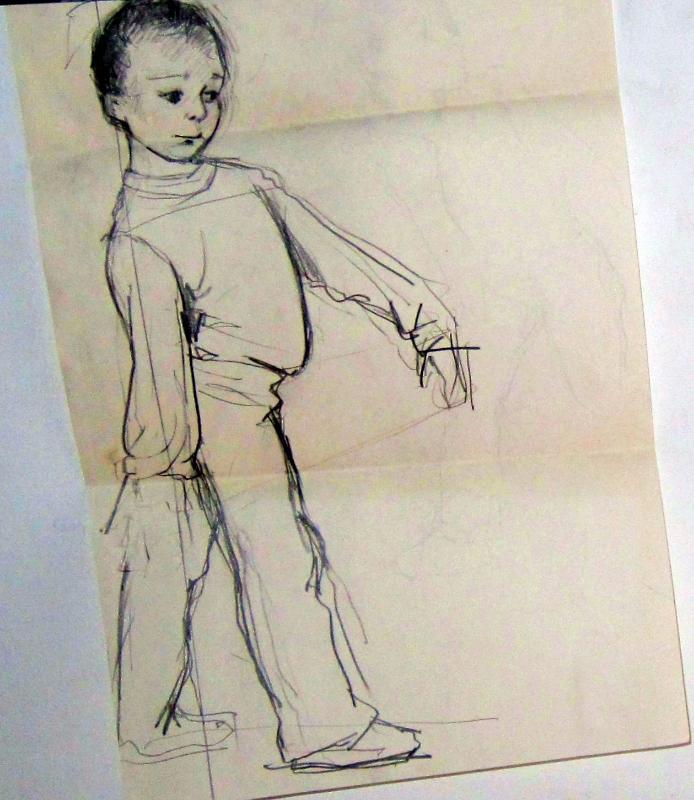
Sketch in art class by Tien Yi Ho


THEREFORE, HENCE FORTH:

"Make a joyful noise!" - proclaims psalmist King David - which is a vocation I can get with.

All this suchness to sing though it may not fill your belly though perhaps the heart swells into sounding, therefore, therein is one's right to PUSH! One may kow tow, or just be cowed, but if the universe is a Thou then one may bullishly assert, NOW! and advocate, even fight for one's birth right - some bread, a bed, a patch beside a stream or a doll house street, sweat-and-blood won, proclaiming a personal kingdom. It's all meat for cosmic forces "running the show." Best to bare the tooth when needed eschewing tempting teats. Now harken! there's laughter of rivers, earthly and cosmic, Milky or Muddy Ways somewhere to be heard. Hard to hear but it's there in our jokes within apparent linear absurdities, i.e. the requirement of Some(No)thing Some(No)where for such suffering, such stunning loss which human and perhaps other one's have sacred duty to scoff at, a reminder of free will though we spill down worm holes devouring our own tails/tales, middle fingers proffered, battered lips praising still that we have witnessed, yes, cracked, all this. And thus with a mortal kiss Love in the crush and crank is sealed.

Another job I endorse - useless kisses toward "a bliss beyond the fiddle."
(Poet Rainer Rilke)


Meanwhile, endure. perdure, either orphan or, certainly,

Overture 

or Ordure 

does an orchard make from stone (peach), 
tomatoes reborn stray between rows and roses 
wilding in heaped woods yard-once'd, 

plankt-ruins' old stead close beside a wagon trail 
barely road/not road, availed centuries shovel-preserved, 
rough-used; 

blood rock, mud mortar,  

aviled red seamed redundancy 

over worked - bruised, 


hoof, foot, wheel 

splay where rose 

thoughts' flowers 

not stray—


remains a 

feminine 

pause, 


a braid of 
purple shade, 

rough pines, 
and poplar, 

one fruit tree still daring.

Sunday, April 14, 2024

REPRISE: Genet By Accident - Faithful As A Pigeon: Of Divine, Her Mythopoesis, A Tribute To Jean Genet & "Our Lady Of The Flowers"

This essay was published October 10, 2017.  I republish it here because it is spring and "the sap's a'risin'" as is said in the Appalachian mountains of North Carolina.  To such sap comes "Our Lady" as sung to, of and for by Jean Genet.

. . . he sang to her gypsy songs that pierced her body . . .

"He may go far away, but he is as faithful as a pigeon." - Jean Genet

ENANTIODROMIA . . . best definition, or one of them, this by Jean Genet: "Her perfume is violent and vulgar. From it we can already tell that she is fond of vulgarity. Divine has sure taste, good taste, and it is most upsetting that life always puts someone so delicate into vulgar positions, into contact with all kinds of filth. She cherishes vulgarity because her greatest love was for a dark skinned gypsy. On him, under him, when with his mouth pressed to hers he sang to her gypsy songs that pierced her body, she learned to submit to the charm of such vulgar cloths as silk and gold braid which are becoming to immodest persons.”
Of Divne, such mythopoeisis: "Let her consent to be the frozen statue. But I know that the poor Demiurge is forced to make his creature in his own image and that he did not invent Lucifer. In my cell, little by little, I shall have to give my thrills to the granite. I shall be alone with it for a long long time, and I shall make it live with my breath and the smell of my farts, both the solemn and the mild ones. It will take me an entire book before I draw her from her petrifaction and little by little impart to her my suffering, little by little deliver her from evil, and, holding her by the hand, lead her to saintliness."
Searching for a passage from Jean Genet's Our Lady of the Flowers (having left the worn out novel at home) a-googling I will go (sung in my best Elmer Fudd voice heh-eh-eh-ehhh), I stumble upon this too too short marvel with said quote, not the full passage I want but will do...of desire there is much to say, and more say than do though do is a fit for another shoe (I'm hunting wabbits Heh-eh-eh-ehhhhh) having been bred a fundamentalist fool from Bayou Evangeline moss to barnacled Baptist pier-ology dour deity, all toxin and lace such is Protestant grace poisoned with too much imagination-for-evil everywhere-in-everything, to convince a child of this so early on is such profanity, unforgiveable....

...when at 18 I came across Genet by accident, a freshman in a Christian college, Our Lady of the Flowers, non-virginal this Our Lady, the pox within broke out as did, some years later, with good analysis, I break down and into Genet-ian cadences, unbathed though sprinkled (not dunked but dipped in good Presbyterian fashion shallow baptismal fountain, a silver bowl is all it wuz-y) (comes eventually unsought "was found blind but now I ssss..."
Jean Genet's deep pool inundation of feeling and evocation "a cadence of veils and sweet cakes"...I came to forgive King David his Bathsheba moment for he once in his youth had but lost his heart and soul to Jonathan, loved him, even exchanged his underwear with him, it's in the Bible true, passion will out so David who murdered a Giant murdered one of his own, ended his best general for what the promise of vision of Bathsheba portended)...what is repentence for - grace all the more - robed in bodies, wants, desires from which we'll all expire while turning such to prayer and dare to live, exchange underwear and more - breath and the heart, the human heart, to teach that divine one there's more to heart than aerie light [makes no sense...just a fun thing to say..such is wabbit hunting].

I needed Catholic Imagination, that of extremes, of heaven, of hell, even limbo where one's toes and more are singed while aroma of Roses — Our Lady tinge noses, infringe upon our all too human suffering for re-evaluation. I found it soon enough in Harlem, in personal estrangement, the city kind, countering the country boy kind, which holds/contains/frames all estrangement, all extremes, a Catholicity most necessary where not only I am redeemed but by poetry and urban/machine sound and rhythm God is redeemed

Sketch portrait of Warren by Paul Brahms some years ago.
 . . . Jean's a saint in my world inner and outer, hiding out in my tower dorm room, the sleep room (such is dormition sleeping) secret communing and whispers, fogs engulfing the tower for weeks at a time, odd in Tennessee wind howl and, again, airee whistle as I moan shut in, enclosed on purpose behind bedsheets and shower curtain, between Holy Bible and Our Lady of the Flowers)(and Graham Green's The Power and the Glory but that's another story to come). . .
. . . an angel visited my little carcair (monk cell) a month ago, palpable beside me as I slept/wept on the pallet on the floor. I could only see the filthy hem of the heavenly once was white robe now gray and stained making me marvel and love all the more...never one for silk and such my desire tucked away till the day of my glad marry to come, had been, had been a thief indeed (Genet's Thief Journal), me, until undone by Christ and Buddha, warriors and wheelturners (chakravartins) both, ensuing for me a redemption of desire and the "dirty world upon my shoulders [and more] (Basho haiku)" -
body full bore to Manhattan then I came, Spanish Harlem replete with Roses, Florida Water, Siete Machos (men's colognes found in Latin America) and more, Puerto Rican/Domincan park bench dominos I would bike by down by the Hudson 3 am bound for Wall Street and Staten Island Ferry some kind of quiet, not mountain quiet that I had in Carolina, but that of early a.m. NYC streets, me tracking graffiti scripture on every train and station wall. I needed what I got, but did not know it too soon but never soon enough, I needed Catholic Imagination, that of extremes, of heaven, of hell, even limbo where one's toes and more are singed while aroma of Roses — Our Lady tinge noses, infringe upon our all too human suffering for re-evaluation. I found it soon enough in Harlem, in personal estrangement, the city kind, countering the country boy kind, which holds/contains/frames all estrangement, all extremes, a Catholicity most necessary where not only I am redeemed but by poetry and urban/machine sound and rhythm God is redeemed and enters, visionary company at last, once again, tracing, tracing (Hart Crane) into the broken world.
Catholicity and France and human gore produced Genet, the give-away grace, the reframe of guilt, blame, small favors of mourning, and such adoration as only parted persons, divided ones, can give. I was "not in Kansas anymore" unless it was a god and flesh storm tornadic with a froo froo instinct, little Toto, in the basket tucked, my anima/myself sucked up and away too into an Oz-y-man-dias such is an occassion for worship (worth-ship, what it means).
A black pentecostal church just next door to my basement room beneath West 142nd Street, the glad shouts, the sad earnest prayers, the tamborine and hand clap intertwine Latin beats, car horns, conga drums alive up the street on stoops all night, breaking bottles, tapping bottle caps on concrete sits young and old men bare-chested, sweating, cigarettes between drumming fingers or loose lips hand play/pound escape from day heat to river cooled darkness...new saturation/inundation for me, no longer the Christhaunted South or nation for that matter but a passionate parenthesis
of so much flesh, perspiration, desire, ejaculation, celebration in-the-face of large Orange Sky, the all night comidas place lively with taxi drivers, orange rice, pork all kinds and cafe con leche only 40 cents a cup...a place to escape one's self p.r.n., all that grease and men....
Enough evocation 1980 Bway and West 142nd and near...the cadence of Genet 1971 in my hand straight to heart, then/now, and now still inwardly wear him, angelic robe all tatters, stains - "I would be a monk but for the dust of the world on my shoulders (Basho)."
“Her perfume is violent and vulgar. From it we can already tell that she is fond of vulgarity. Divine has sure taste, good taste, and it is most upsetting that life always puts someone so delicate into vulgar positions, into contact with all kinds of filth. She cherishes vulgarity because her greatest love was for a dark skinned gypsy. On him, under him, when with his mouth pressed to hers he sang to her gypsy songs that pierced her body, she learned to submit to the charm of such vulgar cloths as silk and gold braid which are becoming to immodest persons.”

Rue art near Focces, Gers, France

"Do you know some poison−poem that would burst my cell into a spray of myosotis? A weapon that would kill the perfect young man who inhabits me and makes me give asylum to a whole agglomeration of animals?. . .Swallows nest under his arms. They have masoned a nest there of dry earth.
Snuff−colored velvet caterpillars mingle with the curls of his hair. Beneath his feet, a hive of bees, and broods of asps behind his eyes. Nothing moves him. Nothing disturbs him, save little girls taking first communion who stick out their tongues at the priest as they clasp their hands and lower their eyes. He is cold as snow. I know he's sly. Gold makes him smile faintly, but if he does smile, he has the grace of angels. What gypsy would be quick enough to rid me of him with an inevitable dagger? It takes promptness, a good eye and a fine indifference. And... the murderer would take his place. He got back this morning from a round of the dives. He had sailors and whores, and one of the tarts has left the trace of a bloody hand on his cheek. He may go far away, but he is as faithful as a pigeon. The other night, an old actress left her camellia in his button−hole. I wanted to crumple it; the petals fell on the rug (but what rug? my cell is paved with flat stones) in big, warm transparent drops of water. I hardly dare look at him now, for my eyes go through his crystal flesh, and all those hard angles make so many rainbows there that that's why I cry. The end.
It doesn't seem like much to you, but yet this poem has relieved me."
You may read the novel online for free here: