Sunday, October 30, 2022

"New Worlds To Gain. . . In Green Sun, On Blue Earth, Under Warm Running Showers" - Of Hamartia/Fatal Flaw of Personas & Alas Of Cultures - Still, Feed Psyches/Souls Despite Apparencies

1972 -me 20 years old in the upper right hand corner.
[click photo to enlarge]

"Jefferson Airplane was a first amendment band in many ways..." - Jack Cassidy, bassist for Jefferson Starship
"we are all outlaws in the eyes of Amerika....we should be together all you people hangin' round together...up against the Wall, up against the Wall, tear down the Wall you muthafvl<ah's ..."- Paul Kantner
Ground control to Major Godot. - Jefferson Airplane

"To quote St. Sam Beckett, "Nothing to be done" but one must try while gnawing at a withered radish and twisting an appearing and disappearing hat in hand. Odd rituals somehow matter even if artifactual (though Jung would argue differently but tonight I am an existentialist). 

Ground control to Major Godot." - Warren Falcon


Needed this tonight [see video linked below the text]. I was a teen in '60's collective insanity which was not insanity but an long overdue uprising for justice, equality, questioning long presuppositional aka pre-conscious/presumed/assumed aka "un-thoughts", aka societal "givens" then-and-still-now-preceding-insisted-upon immoveable (or else) so-called "foundations" [aka preferences/urgencies of threatened Western (aka Supreme) culture etc.).
And now I am 70 y/o and am STILL even more (as I experience it in my seven decades) of collective insanity...and still I experience the need to reconnect with something that made the livid splintered life sentence realer aka more meaningful, meaning at least existence made more sense than was currently that ab-sence force fed to me in harm's hamlet, Stillborn Falls of Major Misieracordia of the Stale Pone and Penance where in my 'yoot', a most most already addled kid/teen, spawned and educated in a Southern (oy!) white culture that couldn't, and still can't, tell its pale ass from a red dirt hole in the ground but made sure with Biblical chapter and verses that that Holy Foot of misperceived God Image remained up every ass, most certainly mine, or else).
In short, I needed/craved an utterly different orientation outside of what the South and the US of A was force feeding and still pawn shopping to masses devoid of the capacity to critically think on their own. Best to pull at that nippled teat attached to every cyber device and venue (including this one) and draw distorted conclusions about what really is...I would refer folks to a study of metaphysics (not that fluffy pipe dream of the New Age) and epistemology but I know at this point that I am blowing smoke up my own ass as I soon enter utterly into oblivion. But oblivion and obliviousity is here and now. Holy cow. Diamond sow. No possum no sop no taters.
That which oriented me and millions in the 60's may not orient exactly the same now, and can't suffice (nor should it necessarily, times/values now being cyberly different and such; yes, Virginia, there is (and was and ever shall be) a death and transformation of once was valid values and world views) in this greatly pathologically advanced (and decaying age) but, still, it helps to locate/home me/myself and still gives me some hope against hope (ah Innocence lost and still seeking to be found) that somehow despite the gargantuan hamartia/hubris of current (first) world culture hypnotized by an old yet present and trending insanity, we shall survive the destined and inevitable fall from inflations (perceived to be grace by gods and self (as gods) bestowed) that ancient Greeks and Hebrews insisted then, and do so still, and many other derivatives and reactions thereof that we have some record of (perceived to be grace and self bestowed), humans owning energies that are not our own but are of transpersonal/trans-human (natural) archetypal sources so are thus, so it appears, to pay for being identified as "gods".
Blah. Blah. Preaching/droning abysmally on into the ADHD Abyss-Mall...
The brief sum is
Hamartia - a fatal flaw leading to the downfall of a tragic hero or heroine) = You are the crown of Creation (title of a record album that came out when I was in the 10th grade - blew my mind and no mushrooms in sight! though there were many in the cow dung in the appearing to be innocent green pastures spread out all around me. But I was still too by the local trance of Christianity spelled. But with Jeff Airplane and many many others there was an underground spring undermining the calcified trance that still, hard to believe now, trances much of the Western world and finds new ground in non-western lands.
SELAH

Me at 18 with a kid on my shoulders at a concert. 
Lifted him so he could see.


Sunday, August 15, 2021

Little Miss Muffet Late Of Her Tuffet, 'She Gone We Know Not Where' — Contexts & Conjectures As Points Of Departure For Father Will, His Storms


I don’t try to reconcile anything’ said the poet at eighty, 
‘This is a damned strange world.’ 
-John Berryman, from "Eleven Addresses To The Lord" 


The original fault 
Will not be undone by fire. 

The original fault was whether wickedness 
Was soluble in art. 
History says it is, 
Jacques Maritain says it is, 

Barely. 
--John Berryman, from "Sonnet ix" 


Once again this babble for Father Will,
his Bible the Holy Surd of God 

Context & Conjecture One 

Thou knowest my down-sitting... Try me, O God, and seek the ground of my heart; prove me, and examine my thoughts. --from Psalm 139 

I have often wondered where Little Miss Muffet was forced to go, and did she, and if she did what became of her, who did she become and what adventures of disorientation did she undergo in order to arrive at a more meaningful reorientation of self with Self—what Carl Jung calls the “Greater Personality” within, with, and from which the ego dwells and swells into conscious being with growing capacities to live the questions, to sit in the contradictions, to dwell within and between the conflict of the opposites. 

Like Siddhartha Guatama Buddha, Miss Muffet had to leave the familiar tuffet, the premature down-sitting, for enough hard living had not been done for she had not yet been more completely exposed to the vicissitudes of existence, disillusionment, moral and other failure, longing, lack, illness, decay, death and, of course, the interplay, the coming and going of and between their opposites. 

Curds and whey, baby food, must be spilled out of the identified-with-Innocence suddenly frightened puerish lap, evidence of the harsh awakening from one form of sitting, unconscious, animal, infantile, collective, dull as a box of hair, into panicked headlong running off the proven riven ways into flight, insecurity, fear, malaise. 

Having partaken, thoroughly exposed to dukkha, meaning suffering, Freud's discontent, the Existentialist's alienation, Miss Muffet can sit down again, having lived and still living the questions, emptied out but for despair, consenting to be there without the collective curd, the theological and cultural whey, with only the weight of existenz pressing her there, now willingly waiting at her Bodhi Tree, now refusing to budge: 

A dark theme keeps me here, Though summer blazes in the vireo's eye. Who would be half possessed By his own nakedness? Waking's my care — 
I'll make a broken music, or I'll die.—from "In Evening Air" by Theodore Roethke 

[Thanks to Morbious Konschturkt for pointing out the aptness of Freud's term, discontent for a contemporary rendering of Buddha's dukkha

Context & Conjecture Two 

Or perhaps like Jesus of Nazareth sweating drops of blood in Gethsemane, resisting the cup of affliction aka God's Will, then consenting to drain the bitter Law that requires even Deity's obeisance, Miss Muffet, too, consents, forgetting the longed for infantile curds and whey, the childish stool, to swallow an incomprehensible means of grace which first lays waste the human into more grief upon the opposites' Cross without promise of resurrection. The resurrection is in surrender, in the swallowing, the vinegar sponge thrust into the finite Savior's mouth punctuating the bitter meal that human will and flesh can become, and that murderous, blood thirsty, killing Will of God. 

First awakening is to the clot-itude, mortal clay pushed and shoved by Fated Hands no matter the just protest of beaten, broken dust. Abjection. When Jesus calls out from the hanging tree, “Father, Father! Why hast thou forsaken me?”, there was no hope in the For-Everyhuman hanging there. And hang we all must and will and do with or without awareness or understanding, without consent (no choice but to relent), without familiar comforts, the curds and whey of everyday mind, the historical nostrums, and consumerist collective cures: 

Bound to my heart as the Ixion to the wheel. 
Nailed to my heart as the Thief upon the Cross 
I hang between our Christ and the gap where the world was lost. 
--Edith Sitwell, from Dirge For The New Sunrise"

Let excursus end

Pretend or pray such 
extends us into more 
than infirm materiality 
but let it rest, or give, 
if rest can be given, 
riven from wrested 
Pleiades retread Maidens 


Context & Conjecture Three 

When I was a child, I spake as a child, I understood as a child, I thought as a child: but when I became a man, I put away childish things. --Paul of Tarsus, 1 Corinthians 13:11 

In last month's essay [click and read here] we read of Father Will's return from a month long retreat where he hoped to gather much needed personal and collective comforts and cures at Bone Cabin, a remote desert cabin in the American west, an extreme, austere and overwhelming environment which exaggerated an already present existential opening in Father Will of what Paul Tillich calls ultimate concerns and exigencies (urgencies) insisted within and upon one either lived consciously or, for many people, consciously repressed and studiously avoided or medicated by now even more devices and gadgets of medicine and machinery, the entertainment juggernaut now being one of the largest consumer industries the world over especially in the postmodern Western world. 

Granted, it is tremendously difficult to endure the questions of ultimate concerns and not rush to “answers” and "solutions". Enduring the questions and the vast spaces they open internally when endured and not medicated or entertained away by doctrinal or other distracting solutions, one may descend into deeper, transpersonal dimensions of Psyche where an authenticating encounter can occur reframing existential dwelling in the world as a regenerative meeting with and relating to Being and Mystery, Existence, consciously discovering its Dynamic Ground in Essence via human awakening. Such relocating meetings at the edge, brief or sustained, require departures from familiar territory, internally and externally, in order to evolve out of these “childish things” St. Paul speaks of, into mature, reality-oriented encounter with existence as is. Often enough, like Miss Muffet, on her secure everyday tuffet one is inexplicably forced out of the comfort and safety of everyday belief and routine. And so with Father Will I must sit in the questions, in the emptying, and not rush to filler solutions. 

I, too, must empty. 

Guggenheim Museum. Bilbao, Spain

Both Carl Jung and W.R. Bion have prescribed this emptying in similar expressions, that when the fellow pilgrim, the patient/client, enters the room and the door is closed one empties oneself of memory, thought, desire. Existential and phenomenological psychology calls this intentional creating of vacated space Epoché helpfully defined by wikipedia as "the theoretical moment where all judgments about the existence of the external world, and consequently all action in the world, is suspended...One's own consciousness is subject to immanent critique so that when such belief is recovered, it will have a firmer grounding in consciousness...one is thought to be able to suspend judgment regarding the general or naive philosophical belief in the existence of the external world, and thus examine phenomena as they are originally given to consciousness. [Read more about epoche here: https://en.wikipedia.org/wiki/Epoché]

In this context of epoché, vacated space, and surrender (etymologically meaning "to render out" much like the slow cooking of meat renders out, separates the fat), one suspends security of belief, even of history, personal and collective, and lives on what Martin Buber calls the narrow ridge, "a narrow rocky ridge between the gulfs where there is no sureness of expressible knowledge but the certainty of meeting what remains undisclosed."  [One may read Buber here in detail re: the narrow ridge here: https://www.religion-online.org/book-chapter/chapter-1-the-narrow-ridge/]

The narrow ridge can be stormy and, since last month Father Will came in from a violent storm, an understanding of storms archetypally may deepen the context of not only his but our collective departure out of the Piscean aeon into the Aquarian we've just entered. 

"My hosanna is born of a furnace of doubt." - Doestoevsky 

Context & Conjecture Four 

Of storms and absolution at the outset, a context for Father Will, for us all as we fall with our Falling Star: We know from world mythology that violent storms have served the offended Higher Powers to destroy old and no longer viable divine and human cultural orders. These storms arrive, post-destruction, to restore, renew, relink Creative Power(s) with creation and from that tempestuous interaction, with culture. It can be said, then, that culture is a crime of passion between the sacred and the profane. Even the gods fight amongst themselves as they should for it is from this divine conflict that the "10,00 things" of creation are manifest and are subject to an Order/Disorder which we humans continually try to divine from which neither the gods nor we can escape being "hurled down against the flat stones of our lives", as American poet, Mark Strand, accurately announces. Gods, too, are hurled down upon stone tablets, unyielding codes, calcified cosmologies representing the flat world of old orders no longer viable because they cannot accommodate the horrific fact of their own shadow (projected upon creatures/creations), the shadow of the institutions formed around them, and of what humans with their brilliant but deadly shadows have been able to technologically create and in the creating awaken globally destructive powers. 

As our gods are so are our determined destructions. Our annihilating bombs along with our balms are images of our contrary and contradictory gods. It is we and creation who suffer them. Thus we are startled awake, overwhelmed in this age of authentic anxiety, of pandemic sleep disorders, of pathological gods (Jung says our gods now show up as pathologies, as symptoms), their religions and our consequent spiritual bypasses. We remain warily, scarily aware of this cosmic set up in this crushing, cranking cosmological turn of the Wheel since the old and current centers and the meaning they once provided do not, apparently will not, hold because they carry internally their own apocalyptic seeds of destruction in order to be renewed, a process en perpetua, called renaissance, which is a hope but not a guarantee or given. We are in this condition where "the center cannot hold...things fall apart," to quote William Butler Yeats. 

Carl Jung indicates that we are moving through this threshold of chaos and kairos

"A mood of universal destruction and renewal has set its mark on our age. This mood makes itself felt everywhere, politically, socially and philosophically. We are living in what the Greeks called the KAIROS - The Right Moment - for a “metamorphosis of the gods”, of the fundamental principles and symbols... So much is at stake and so much depends on the psychological constitution of the modern human.” -C.G. Jung, The Undiscovered Self 

"Kairos is the passing moment in which something happens as the time unfolds...it is a small window of becoming and opportunity. One of the origins of the word comes from shepherds watching the stars. As the night progresses and the stars turn in the sky, they appear to rise and then fall against the horizon. The moment when a star has reached its apogee and appears to change direction from ascending to descending is its kairos." --Corrigall, J, Payne, H, Wilkinson, H (eds), About A Body, 2006: pg. 201 

Like it or not, Father Will expresses/compresses/distresses within this context of chaos and kairos, the falling star of our Aeon (symbolically, stars partially represent particular meaning points, archetypally specific constellations/apparitions of consciousness). In so doing he speaks for us all though we may hide our heads in bestseller, consumerist New Age and similar sands, vacuous, temporary spiritualish confections, or alternately/alternatively, calcified and calcifying Fundamentalist invectives and insurrections, denial or bile by any other name, sympathetic magic flailing or doctrinaire dogma flagellating against the tragic condition of gods and man, self-righteous fingers or hand folded namastes pointing actively or passively at the scapegoated causes. This understandable but narcotic narcissism in the end will not lead us through this nekyia ("night sea journey") like Odysseus to that newly discovered inland terra firma where we must plant our hand hewn oar carried far from familiar seas and shores. 

The fullness of this time, Kairos of the falling star (which is a violent storm, indeed), of cultural/cosmological dis-aster (meaning, ill-starred), is reliant upon human capacities such as they are but effective enough, to proclaim, reclaim and proceed to ongoingly integrate shadow, human and divine, for this is the work not only of egos but of eras. It is also a time to grow equally enduring capacities for disorder, for chaos, so as not to blame or punish gods, Nature nor humans for what appears to be a primary given of existence, entropy, which is inevitable social, physical and energetic decline and degeneration. In tandem with entropy there are or can be evolving human capacities for what I call syntropy where we may more consciously witness and participate in the inexorable falling apart while keeping meaning-threads in mindful hands while winding and finding our way within and potentially out of one labyrinthine Wheel Turn into newer ones of potentially creative/destructive formations. Ensuing personal, collective and cosmological gains may be derived from willful Time's twining whorl and wheal* for this Fateful ordeal of inevitable wandering is imposed by appointed rising and falling stars, ours and our cultures' scars the signatures of their greater impositions. 

Ah, but now I hear Father Will growling, "But who or what is it appoints the stars?" 

[* "wheal -- mark made on the skin by a whip," 1808, probably an alteration of wale, possibly by confusion with weal "welt," and obsolete wheal "pimple, pustule" (1440), from O.E. verb hwelian"to form pus, bring to a head." 


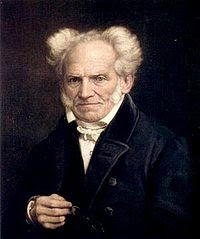
[Portrait of Arthur Schopenhauer, the 1800's German philosopher and inspiration for our Father Will who reappears in this month's essay to quarrel, and in quarreling make confession, with Existenz, his own, mine, the Church's, the New Age and more because of and amidst the persistent agonies. Father Will returns to us here first introduced in my March and October 2009 Learning For Life Group Newsletter essays also found here on the blogspot (click 'March (2)' and 'October (2) under 'Blog Archive'). The retired and retiring, troubled and troubling, goodly Father is a composite character, a convenient and necessary fiction drawn from my practice comprised of many, composed by one. I've chosen his name, Father Will, to signify Human Volition, Will to Power/Will to Cower in homage to Schopenhauer who wrote The World As Will And Representation (To get a sense of his philosophy go here: http://en.wikipedia.org/wiki/Arthur_Schopenhauer). However, any resemblance to an actual person is completely accidental unless it is an oblique locution referring to me. Credit for the painting here of Herr Schopenhaeur is from wikipedia online: "This portrait of Schopenhauer was painted in April 1859 by J. Lunteschutz...This image... is in the public domain because its copyright has expired."]

Ghosts. Ordinary planks propped against the wall
in a Santa Fe, NM museum.

Further Pretexts for Absence: Quotes from Other Folks Who Have Opinion on the Matter

You shall know the truth, and the truth shall make you odd. -- Flannery O'Connor 

"Artaud warns his readers and listeners that each person who knows conflict and seeks to grow, must expect a shearing of flesh and a letting go of blood in the act of life which is a cruelty

To be you can let yourself go until you just exist, but to live, you must be someone, to be someone, you must have a Bone, not be afraid to show the bone and to lose the meat by the wayside. And what is infinity? We do not know exactly. It is a word which we use to indicate WIDENING of our consciousness toward the inordinate, inexhaustible and inordinate feasibility. 

...but there is one thing which is something, only one thing which is something, that I feel wants to COME OUT: the presence of my bodily pain, the menacing never increasing presence of my body. 

To live meant to Artaud--to act, to hurt and be hurt, to experience fully joy and pain, and in so doing, to mold, create--and recreate oneself in the process..."I hate and renounce as a coward every being who consents to live without first having created himself." 
--from Artaud, Man of Vision, Bettina L. Knapp, First Swallow Press / Ohio University Press edition 1980, from the Preface, pg. 217-218, pg. 214 

And if the babe is born a boy 
He’s given to a woman old, 
Who nails him down upon a rock, 
Catches his shrieks in cups of gold. -- William Blake*** 

Obit anus, abit onus ("The old woman dies, the burden is lifted") --Arthur Schopenhauer**** 

According to Julia Kristeva in the Powers of Horror, the abject refers to the human reaction (horror, vomit) to a threatened breakdown in meaning caused by the loss of the distinction between subject and object or between self and other. The primary example for what causes such a reaction is the corpse (which traumatically reminds us of our own materiality); however, other items can elicit the same reaction: the open wound, shit, sewage, even the skin that forms on the surface of warm milk.--from a Purdue University web article: The abject for Kristeva is, therefore, closely tied both to religion and to art, which she sees as two ways of purifying the abject: "The various means of purifying the abject—the various catharses—make up the history of religions, and end up with that catharsis par excellence called art, both on the far and near side of religion". --http://www.cla.purdue.edu/english/theory/psychoanalysis/kristevaabject.html 


At times one might say: "In the beginning there was nourishment." 

At times one might say: "In the beginning there was catastrophe." 

Bion's writings give voice to the traumatized self. If Walt Whitman sings the body electric and catalogues joys of self, Bion details what it is like for self to be electrocuted and to continue as the remains...Destruction turns up and screaming substitutes for satisfaction. Bion is most keenly Bion in depicting destructive transformations of the scream as link. He is particularly master of the fading scream, the scream that dies forever, background radiation of spaceless space, the dispersed scream...Silence explodes...From nourishment to explosive wipe-out." 
--from Damaged Bonds, Michael Eigen, H. Karnac (Books) Ltd, 2001, pgs. 29-30 

In a field I am the absence of field. — Mark Strand 

Becoming and transformation are tasks imposed on man by Fate, working both from within and without him, and this is something which man becomes aware of at the turning points, the crises of his existence. In so far as man experiences such crises with anxiety and under the image of inescapable death he also experiences himself as one disposed by nature to transcend his existence as it is at any moment and to experience and express previously unknown possibilities. 
-- The Dream and the Underworld, James Hillman, New York: Harper & Row, 1979, pg. 113 

This essay is dedicated to dearly departed Karen Eberle, Tien Ho, Walter Schell, and last but not at all least, the astonishing Marianne Annur: "It means so much that we can be broken..." 
--Raul Voz, from Las Poemas Cornadas (The Cornada Poems)

"We do not mourn that we see through a glass darkly, 
we now rejoice in the dark loveliness of the glass." 
- John Dominic Crossan 

"You barricade yourself from the world with exaggerated saviour fantasies.
Come down off the mountain of your humility and follow your nose." 
- C. G. Jung


Pilgrim close-up.  Mont-de-Marsan, Gers, France


Advent Letter To An Old Philosopher In Rome - What Knees Are For

for Father Will

"Dear incomprehension, it's thanks to you I'll be myself in the end." - Samuel Beckett, The Unnamable 

"We make no claim to include anything of the past in the present but to maintain in the present the actuality of the eternal." - Jacques Maritain


1
Old Friend, from one desert to another, 

let other scholars of absence break 
their burden-heads against these mute
stones. The cactus here, perhaps knowing 
of your advent by post, has waited all 
these years to come into its radiance 
with you. Just tonight it blooms once 
only in its life, a miracle itself, a startle, 
one blossom of rarified hope. 

Distant cousin, 

you unveil too in Roman darkness there as 
we once shared silent prayer in the churchyard, 
our knees on hard stones - our God then - our 
thin books not yet written.

One simple stone veils you where you rest, 
your books, long in the making, shoulder the 
burden so faithfully carried without complaint. 
A landscape scarred - life's hard impress has 
etched you - is now placed, framed, beside 
the new flower, sheer and here.

I wonder how you are now that you are prayer itself 
on that hill of bones wet with penitent pilgrims tears.

Your photograph travels all these years to 
reach me so long without news of you, my 
letters unanswered though rumors stray in 
from the same old rivals fed on envy inquiring
about you. I never bother to answer them. 

The postman, angel at the gate, has firmly 
placed in my hands your parcel of plain brown 
paper from ROMA — proclaims bold print framed 

beside the other framed —

Dear Unexpected Face. 

To see you at last, your resigned smile finally, 
gladly, admitting surrender - such repose is
an altar where incomprehension finally breaks 
into blossom - Emptiness is Presence Divined 
in any landscape or ocean. Or mind. 


On the back of your photo you ask simply, 
briefly, a note scribbled by a weak hand, 

How fare's you, 
God's mason friend? 


2
I stammer on scraping skin and song, 
a geography myself, a landscape severe, 
gone in the nose and ears, the eyes
good now for shadows only. And some 
old beloved words. But I'll plead allergies. 

I am reading some dead Thomists 
these days, Maritain, your friend, 
whom I've secretly adored since 
covenants were broken, my own 
fault, asking again and again how 
one can keep covenant with self 
much less a God. 

Bless my bones if there are blessings
for such. I've taken them for granted
much. They are my formation base.
I've wasted years chasing the world, 
the words for things, and why and 
how, I never really thought of bones 
but old Thomists did and do, even 
Calvinist too though they're way too 
dry for me.

Maritain frees me, as does his wife, 
the gentleness in them both astounds.
Jacques's a tough bird, though, an 
intellect staking claim on thought and
what perhaps it ought to do with silly
human will once Divinity has entered
the room —

What knees are for upturned palms can plead.

NOW

sings bones

their old hymns ongoing theme.


Somewhere I read, or did I dream it, 
an old heresiarch in the desert retreated 
to cultivate a life of prayer in nowhere.
After all the years of abstention and
heat, the bare land inexorable, he could 
no longer utter much at all, speechless
before severity, and beauty, how the 
eternal question of "why is man" could 
be summed in his only prayer: 


"Heres breath for you."

Tuesday, March 30, 2021

Roof, Rexroth, Blossoms, Bridges, Zen-itude - Views Above Windows

[I took this photo about 12 years ago (2010), my first spring in the studio apt, a new digital camera gifted to me so my arm plunged out the window often to snap mostly wasted images…but a few as usual were keepers or, rather, keepers enough. Click on the image to get a larger view.] 

Kenneth Rexroth is good reading now while I'm on the roof, first roof sit of the too too brief warm-enough/cool-enough season for sitting on the layered tar rolled flat reflecting gray from a clear sky (the roof will be unbearable to sit on by April's end). Fragmental view of bridges Manhattan and an edge of Brooklyn Bridge framed by buildings East and riverward…so, reading Rexroth, an early teacher for me in Blue Ridge tree tops 1970's then, and then with his translations of Chinese poems too which are now with me on the roof NYC 2016, the cover's wrecked, stained, torn, the edges brown and where the scorch came from I have no recall at all but clearly some flame or other got to the spine of it and burned the gray to dark brown and black. But the book still works and my hands are gentle with the pages, the spine weak and cracked, my thumb's a gentle press to hold it all together, tenuous though. The poems strong though. 

I lean over the brick ledge to peer east and down East 10 Street to quaff the view of bright off-white buds of trees just a few arms length below me, I would so gather them to me if I could but my reach is not long enough so the eyes must do, the stubborn ginkgoes refusing to open; they contrast against red brick and buds bright left and right of each twining limb dark, thin, black studs/nipples where leaves want to be but not yet, not yet. The aroma of the blossoming trees is strikingly sexual, male, though the eye sees the graceful flower an entire tree becomes before green has its long free run over the eyes and street--Not yet "green, how I want you green…" Not yet - "not my hands but green across you now" but these Rexroth essays and translations, and some Shinkichi Takahashi zen surrealist incantations for linear assonance and sumi-e mental negative space…Some Rexroth here accounts for such clear trances, the utility of them in an age bereft of substantial visions (though the essay's not about Takahashi but could be): 

"Poetry such as this attempts not just a new syntax of the word. Its revolution is aimed at the syntax of the mind itself. Its structuring of experience is purposive, not dreamlike. We are dealing with a self-induced, or naturally or mysteriously come by, creative state from which two of the most fundamental human activities diverge, the aesthetic and the mystic act. The creative matrix is the same in both, and it is that state of being that is most peculiarly and characteristically human, as the resulting aesthetic and mystic experience is the purist form of human act. There is a great deal of overlapping, today especially, when art is all the religion most people have and when they demand of it experiences that few people of the past demanded of religion....A visionary poem is not a vision. The religious experience is necessitated and ultimate." -- Kenneth Rexroth, World Outside the Window, the Selected Essays of Kenneth Rexroth, pg. 255-256

Friday, March 12, 2021

REPRISE (first published 11/30/2009): Little Miss Muffet Late Of Her Tuffet 'She Gone We Know Not Where' - Contexts & Conjectures As Points Of Departure For Father Will, His Storms

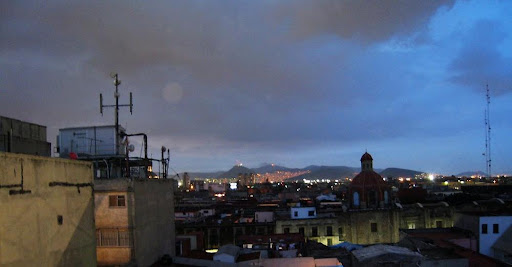
["Mexico City Northwest Twilight". Photo by Warren Falcon. August 2009. Click on the image to enlarge it.] ‘I don’t try to reconcile anything’ said the poet at eighty, ‘This is a damned strange world.’ --John Berryman, from "Eleven Addresses To The Lord" The original fault Will not be undone by fire. The original fault was whether wickedness Was soluble in art. History says it is, Jacques Maritain says it is, Barely. --John Berryman, from "Sonnet ix" Once again this babble for Father Will his Bible the Holy Surd of God Context & Conjecture One Thou knowest my down-sitting... Try me, O God, and seek the ground of my heart; prove me, and examine my thoughts. --from Psalm 139 I have often wondered where Little Miss Muffet was forced to go, and did she, and if she did what became of her, who did she become and what adventures of disorientation did she undergo in order to arrive at a more meaningful reorientation of self with Self--what Carl Jung calls the “greater personality” from which the ego dwells and swells into conscious being with growing capacities to live the questions, to sit in the contradictions, to dwell within and between the conflict of the opposites. Like Siddhartha Guatama Buddha, Miss Muffet had to leave the familiar tuffet, the premature down-sitting, for enough hard living had not been done for she had not yet been more completely exposed to the vicissitudes of existence--disillusionment, moral and other failure, longing, lack, illness, decay, death and, of course, the interplay, the coming and going of their opposites. Curds and whey, baby food, must be spilled out of the identified-with-Innocence now frightened puerish lap, evidence of the harsh awakening from one form of sitting--unconscious, animal, infantile, collective, dull as a box of hair--into paniced headlong running off the proven riven ways into flight, insecurity, fear, malais. Once more thoroughly exposed to dukkha, meaning suffering, Freud's discontent, the Existentialist's alienation, Miss Muffet can sit down again, having lived and still living the questions, emptied out but for despair, consenting to be there without the collective curd, the theological and cultural whey, with only the weight of existenz pressing her there, now willingly waiting at her Bodhi Tree, now refusing to budge: A dark theme keeps me here though summer blazes in the vireo's eye. Who would be half possessed by his own nakedness? Waking's my care. I'll make a broken music, or I'll die. --from "In Evening Air", by Theodore Roethke [Thanks to Thomas Dybek for pointing out the aptness of Freud's term, discontent, for a contemporary rendering of Buddha's dukkha] Context & Conjecture Two Or perhaps like Jesus of Nazareth sweating drops of blood in Gethsemane, resisting the cup of affliction, God's Will, then consenting to drain the bitter Law that requires even Deity's obeisance, Miss Muffet, too, consents, forgetting the longed for infantile curds and whey, the childish stool, to swallow an incomprehensible means of grace which first lays waste the human into more grief upon the opposites' Cross without promise of resurrection. There is a resurrection in surrender, in the swallowing, the vinegar sponge thrust into the finite Savior's mouth punctuating the bitter meal that human will and flesh can become, and that killing Will of God. First awakening is to the clot-itude, the clay pushed and shoved by Fated Hands no matter the just protest of beaten, broken dust. When Jesus calls out from the hanging tree, “Father, Father! Why hast thou forsaken me?”, there was no hope in the For-Everyman hanging there. And hang we all must and will and do with or without awareness or understanding, without consent, without familiar comforts, the curds and whey of everyday mind, the historical nostrums, and consumerist collective cures: Bound to my heart as the Ixion to the wheel. Nailed to my heart as the Thief upon the Cross I hang between our Christ and the gap where the world was lost. --Edith Sitwell, from Dirge For The New Sunrise Context & Conjecture Three When I was a child, I spake as a child, I understood as a child, I thought as a child: but when I became a man, I put away childish things. --Paul of Tarsus, 1 Corinthians 13:11 In last month's newsletter we read of Father Will's return from a month long retreat from personal and collective comforts and cures at Bone Cabin, a remote desert cabin in the American west, an extreme, austere and overwhelming environment which exaggerated an already present existential opening in Father Will with what Paul Tillich calls ultimate concerns and exigencies (urgencies) insisted within and upon one either lived consciously or, for many people, consciously repressed and studiously avoided or medicated by now even more devices and gadgets of medicine and machinery, the entertainment juggernaut now being one of the largest consumer industries the world over especially in the postmodern Western world. Granted, it is tremendously difficult to endure the questions of ultimate concerns and not rush to “answers” and "solutions". Enduring the questions and the vast spaces they open internally when endured and not medicated or entertained away by doctrinal or other distracting solutions, one may descend into deeper, transpersonal dimensions of Psyche where an authenticating encounter occurs reframing existential dwelling in the world as a regenerative meeting with and relating to Being and Mystery, Existenz consciously discovering its Dynamic Ground in Essence via human awakening. Such relocating meetings at the edge, brief or sustained, require departures from familiar territory, internally and externally, in order to evolve out of these “childish things” St. Paul speaks of, into mature, reality oriented encounter with existence. Often enough, like Miss Muffet, on her secure everyday tuffet one is inexplicably forced out of the comfort and safety of everyday belief and routine. And so with Father Will I must sit in the questions, in the emptying and not rush to filler solutions. I, too, must empty. Both Carl Jung and W.R. Bion have prescribed this in similar expressions, that when the fellow pilgrim--the patient/client-- enters the room and the door is shut one empties oneself of memory, thought, desire. Existential and phenomenological psychology calls this intentional creating of vacated space Epoché helpfully defined by wikipedia as "the theoretical moment where all judgments about the existence of the external world, and consequently all action in the world, is suspended...One's own consciousness is subject to immanent critique so that when such belief is recovered, it will have a firmer grounding in consciousness...one is thought to be able to suspend judgment regarding the general or naive philosophical belief in the existence of the external world, and thus examine phenomena as they are originally given to consciousness. (http://en.wikipedia.org/wiki/Epoch%C3%A9) (copy and paste this and all links in this text) In this context of epoché, vacated space, and surrender (etymologically meaning "to render out" much like the slow cooking of meat renders out, separates the fat), one departs the security of belief, even of history, personal and collective, and lives on what Martin Buber calls the narrow ridge, "a narrow rocky ridge between the gulfs where there is no sureness of expressible knowledge but the certainty of meeting what remains undisclosed.’"http://www.religion-online.org/showchapter.asp?title=459&C=371) The narrow ridge can be stormy and since last month Father Will came in from the violent storm an understanding of storms archetypally may deepen the context of not only his but our collective departure out of the Piscean aeon into the Aquarian: Context & Conjecture Four Of storms and absolution at the outset, a context for Father Will, for us all as we fall with our Falling Star: We know from world mythology that violent storms have served the offended Higher Powers to destroy old and no longer viable divine and human cultural orders. These storms arrive, post-destruction, to restore, renew, relink Creative Power(s) with creation and from that tempestuous interaction, with culture. It can be said, then, that culture is a crime of passion between the sacred and the profane. Even the gods fight amongst themselves as they should for it is from this divine conflict that the "10,00 things" of creation are manifest and are subject to an Order/Disorder which we humans continually try to divine from which neither the gods nor we can escape being "hurled down against the flat stones of our lives", as American poet, Mark Strand, accurately announces. Gods, too, are hurled down upon stone tablets, unyielding codes, calcified cosmologies representing the flat world of old orders no longer viable because they cannot accommodate the horrific fact of their own shadow (projected upon creatures/creations), the shadow of the institutions formed around them, and of what humans with their brilliant but deadly shadows have been able to technologically create and in the creating awaken globally destructive powers. As our gods are so are our determined destructions. Our annihilating bombs along with our balms are images of our contrary and contradictory gods. It is we and creation who suffer them. Thus we are startled awake, overwhelmed in this age of authentic anxiety, of pandemic sleep disorders, of pathological gods (Jung says our gods now show up as pathologies, as symptoms), their religions and our consequent spiritual bypasses. We remain warily, scarily aware of this cosmic set up in this crushing, cranking cosmological turn of the Wheel since the old and current centers and the meaning they once provided do not, apparently will not, hold because they carry internally their own apocalyptic seeds of destruction in order to be renewed, a process en perpetua, called renaissance, which is a hope but not a guarantee or given. We are in this condition where "the center cannot hold...things fall apart," to quote William Butler Yeats. Carl Jung indicates that we are moving through this threshold of chaos and kairos: "A mood of universal destruction and renewal has set its mark on our age. This mood makes itself felt everywhere, politically, socially and philosophically. We are living in what the Greeks called the KAIROS - The Right Moment - for a “metamorphosis of the gods”, of the fundamental principles and symbols... So much is at stake and so much depends on the psychological constitution of the modern human.” -C.G. Jung, The Undiscovered Self "Kairos is the passing moment in which something happens as the time unfolds...it is a small window of becoming and opportunity. One of the origins of the word comes from shepherds watching the stars. As the night progresses and the stars turn in the sky, they appear to rise and then fall against the horizon. The moment when a star has reached its apogee and appears to change direction from ascending to descending is its kairos." --Corrigall, J, Payne, H, Wilkinson, H (eds), About A Body, 2006: pg. 201 Like it or not, Father Will expresses/compresses/distresses within this context of chaos and kairos, the falling star of our Aeon (symbolically, stars partially represent particular meaning points, archetypally specific constellations/apparitions of consciousness). In so doing he speaks for us all though we may hide our heads in bestseller, consumerist New Age and similar sands, vacuous, temporary spiritualish confections, or alternately/alternatively, calcified and calcifying Fundamentalist invectives and insurrections, denial or bile by any other name, sympathetic magic flailing or doctrinaire dogma flagellating against the tragic condition of gods and man, self-righteous fingers or hand folded namastes pointing actively or passively at the scapegoated causes. This understandable but narcotic narcissism in the end will not lead us through this nekyia ("night sea journey") like Odysseus to that newly discovered inland terra firma where we must plant our hand hewn oar carried far from familiar seas and shores. The fullness of this time, Kairos of the falling star (which is a violent storm, indeed), of cultural/cosmological dis-aster (meaning, ill-starred), is reliant upon human capacities such as they are but effective enough, to proclaim, reclaim and proceed to ongoingly integrate shadow, human and divine, for this is the work not only of egos but of eras. It is also a time to grow equally enduring capacities for disorder, for chaos, so as not to blame or punish gods, Nature nor humans for what appears to be a primary given of existence, entropy, which is inevitable social, physical and energetic decline and degeneration. In tandem with entropy there are or can be evolving human capacities for what I call syntropy where we may more consciously witness and participate in the inexorable falling apart while keeping meaning-threads in mindful hands while winding and finding our way within and potentially out of one labyrinthine Wheel Turn into newer ones of potentially creative/destructive formations. Ensuing personal, collective and cosmological gains may be derived from willful Time's twining whorl and wheal* for this Fateful ordeal of inevitable wandering is imposed by appointed rising and falling stars, ours and our cultures' scars the signatures of their greater impositions. Ah, but now I hear Father Will growling, "But who or what is it appoints the stars?" [* "wheal -- mark made on the skin by a whip," 1808, probably an alteration of wale, possibly by confusion with weal "welt," and obsolete wheal "pimple, pustule" (1440), from O.E. verb hwelian"to form pus, bring to a head." [Portrait of Arthur Schopenhauer, the 1800's German philosopher and inspiration for our Father Will who reappears in this month's essay to quarrel, and in quarreling make confession, with Existenz, his own, mine, the Church's, the New Age and more because of and amidst the persistent agonies. Father Will returns to us here first introduced in my March and October 2009 Learning For Life Group Newsletter essays also found here on the blogspot (click 'March (2)' and 'October (2) under 'Blog Archive'). The retired and retiring, troubled and troubling, goodly Father is a composite character, a convenient and necessary fiction drawn from my practice comprised of many, composed by one. I've chosen his name, Father Will, to signify Human Volition, Will to Power/Will to Cower in homage to Schopenhauer who wrote The World As Will And Representation (To get a sense of his philosophy go here: http://en.wikipedia.org/wiki/Arthur_Schopenhauer). However, any resemblance to an actual person is completely accidental unless it is an oblique locution referring to me. Credit for the painting here of Herr Schopenhaeur is from wikipedia online: "This portrait of Schopenhauer was painted in April 1859 by J. Lunteschutz...This image... is in the public domain because its copyright has expired." Further Pretexts for Absence: You shall know the truth, and the truth shall make you odd. -- Flannery O'Connor Artaud warns his readers and listeners that each person who knows conflict and seeks to grow, must expect a shearing of flesh and a letting go of blood in the act of life which is a cruelty. To be you can let yourself go until you just exist, but to live, you must be someone, to be someone, you must have a Bone, not be afraid to show the bone and to lose the meat by the wayside. And what is infinity? We do not know exactly. It is a word which we use to indicate WIDENING of our consciousness toward the inordinate, inexhaustible and inordinate feasibility. ...but there is one thing which is something, only one thing which is something, that I feel wants to COME OUT: the presence of my bodily pain, the menacing never increasing presence of my body. To live meant to Artaud--to act, to hurt and be hurt, to experience fully joy and pain, and in so doing, to mold, create--and recreate oneself in the process..."I hate and renounce as a coward every being who consents to live without first having created himself." --from Artaud, Man of Vision, Bettina L. Knapp, First Swallow Press / Ohio University Press edition 1980, from the Preface, pg. 217-218, pg. 214 And if the babe is born a boy He’s given to a woman old, Who nails him down upon a rock, Catches his shrieks in cups of gold. -- William Blake*** Obit anus, abit onus ("The old woman dies, the burden is lifted") --Arthur Schopenhauer**** According to Julia Kristeva in the Powers of Horror, the abject refers to the human reaction (horror, vomit) to a threatened breakdown in meaning caused by the loss of the distinction between subject and object or between self and other. The primary example for what causes such a reaction is the corpse (which traumatically reminds us of our own materiality); however, other items can elicit the same reaction: the open wound, shit, sewage, even the skin that forms on the surface of warm milk.--from a Purdue University web article: The abject for Kristeva is, therefore, closely tied both to religion and to art, which she sees as two ways of purifying the abject: "The various means of purifying the abject—the various catharses—make up the history of religions, and end up with that catharsis par excellence called art, both on the far and near side of religion". --http://www.cla.purdue.edu/english/theory/psychoanalysis/kristevaabject.html At times one might say: "In the beginning there was nourishment." At times one might say: "In the beginning there was catastrophe." Bion's writings give voice to the traumatized self. If Walt Whitman sings the body electric and catalogues joys of self, Bion details what it is like for self to be electrocuted and to continue as the remains...Destruction turns up and screaming substitutes for satisfaction. Bion is most keenly Bion in depicting destructive transformations of the scream as link. He is particularly master of the fading scream, the scream that dies forever, background radiation of spaceless space, the dispersed scream...Silence explodes...From nourishment to explosive wipe-out." --from Damaged Bonds, Michael Eigen, H. Karnac (Books) Ltd, 2001, pgs. 29-30 In a field I am the absence of field. --Mark Strand Becoming and transformation are tasks imposed on man by Fate, working both from within and without him, and this is something which man becomes aware of at the turning points, the crises of his existence. In so far as man experiences such crises with anxiety and under the image of inescapable death he also experiences himself as one disposed by nature to transcend his existence as it is at any moment and to experience and express previously unknown possibilities. -- The Dream and the Underworld, James Hillman, New York: Harper & Row, 1979, pg. 113 This essay is dedicated to dearly departed Karen Eberle, Tien Ho, Walter Schell, and last but not at all least, the astonishing Marianne Annur: "It means so much that we can be broken..." --Raul Voz, from Las Poemas Cornadas (The Cornada Poems)

Thursday, February 18, 2021

from 'Inherited Brood Of Brothers, Wherever You May Sway, Remember To Be Gay - Imagined Letters Whitman May Have Penned To The New Millenium by Norman Nightingale

"I confess to myself a perhaps capricious fondness for it."
-- Walt Whitman on this photograph


But I shall use that 'net' and my still goodly paper and goodly pen to dim whatever ill tides there are and to come, as they surely will in spite of low wattage, jangle keys on the night watches, read my mystic books, make my prayers with roamers of wards and wharves glancing up considering bridges, edges, silty bottoms. The tides are here even now. But right now I wish to sing a lullaby in protest to those hurting departed, even to those coming ills, that I may sing innocence dumbly back to those who may come ashore again more gently having forgotten enforcing depths insisting them toward resistant yet resolved embraces...

...So breech then, waves. Feet first. Heads in the brine. I shall keep time on your wrinkled toes sticking up from the sand, play peek-a-boo. Then while you sleep I shall harvest gently, place them firmly in that old woman's shoe with 'so many children she didn't know what to do.'
She may yet have learned what to by now. I haven't.
I remain bitter. Abject, too, from the senseless loss of cast off young men who could not endure the flame, the rust, no fault of their own, who leap blasted from bridges, forced by killing human edges, who are broken open within and by hateful, fearful others forgetting, if ever had, those restorative burning constancies of a Mother's loving hand upon them.
I have placed their names and images upon my altar beside García Lorca's portrait, and Hart Crane's young face, an image of a sweet Christ holding a lamb in perpetua, and the yellowed newspaper clipping from Spain of the Matador's death, all who have joined or will join Hart becoming ghostly visionary company. They now remain forever chaste not having lived long enough to be wasted, to be emptied loving deeply out into Love for more, endlessly bleeding out as Lorca, a corrida of laurel encircling his head no longer remembering but only one sound, guns exploding outward, extending, bullets, petals, one by one beyond the wall where he stood before the obedient squad stunned, 'how young and handsome are the assassins' faces.' Obedient to projectiles and projections he flew backward into the restraining wall, his brave shadow and blood, then fell, a last poem frozen upon lips but for circling birds, spirits, carrion or both, arriving after blood.
Reduced to foolish whispers, restoring moments, patient hidden gods, human hearts and bodies remove themselves from the potter's wheel too early broken, too tired, too alone to try to shape love from Love from the tiny shard, the remnant bone of the ancient mastodon, the last one, dreaming within each heart of that Love which all Nature yearns for.
Inherited brood of brothers wherever you may sway remember to be gay for all the gray afternoons in this sad but forgiving confessional while not forgetting mine and the cock's quarrel with life in the booth by the cracked window near the corner of 7th and Second.
Trembling,
Nightingale
from Inherited Brood Of Brothers Wherever You May Sway, Remember To Be Gay, Letters Whitman May Have Penned To The New Millenium by Norman NIghtingale